Workforce Wednesday: Becoming a Veterinarian


From sled dogs and house cats to seals and bears, veterinarians in Alaska have a wide variety of animals to care for. The pay isn’t bad either. According to Martha Peck with Alaska Process Industry Careers Consortium, veterinarians make roughly $7,800 a month. Vet technicians make roughly $3,500 and assistants pull in $2,400.

Erin Earhart, a veterinarian with The Pet Stop, says the best way to get involved is to shadow at a clinic to see if it will be a good fit. One way to get involved is to start in an entry level position, like a receptionist, and work up from there. Jobs aren’t limited to just one field. Skills can transfer to Anchorage Animal Care and Control to retail space as well.

To get started in high school, King Career Center in Anchorage, and Mat-Su Career Tech High School are good places.

“The University of Alaska Fairbanks, in partnership with Colorado State University, has a program where you spend two years at UAF and go down to Colorado State to complete that degree,” Peck added. There are even online options available.

To explore this career and more, visit the Alaska Process Industry Careers Consortium website.

Watch the full video segment here.

Source: Workforce Wednesday: Becoming a veterinarian | KTVA 11

Four DNP Graduates Reach Nursing’s Educational Pinnacle at UAA

(Photo by Philip Hall / University of Alaska Anchorage)

Four women—Jyll Green, Jill Rife, Leigh Keefer and Robin Bassett—became the first students accepted into UAA’s Doctor of Nursing Practice (DNP) program and, 15 months later, the first to accept their DNP diplomas at UAA’s fall commencement last month. The DNP is the highest degree offered in the nursing profession.

“Even in 2005 when I started getting my master’s, there was discussion in the literature about the DNP being required for entry into advanced practice,” said Robin Bassett, one of the inaugural four UAA DNP graduates.

Read the full article here.

Source: Four DNP graduates reach nursing’s educational pinnacle, at UAA – Green & Gold News

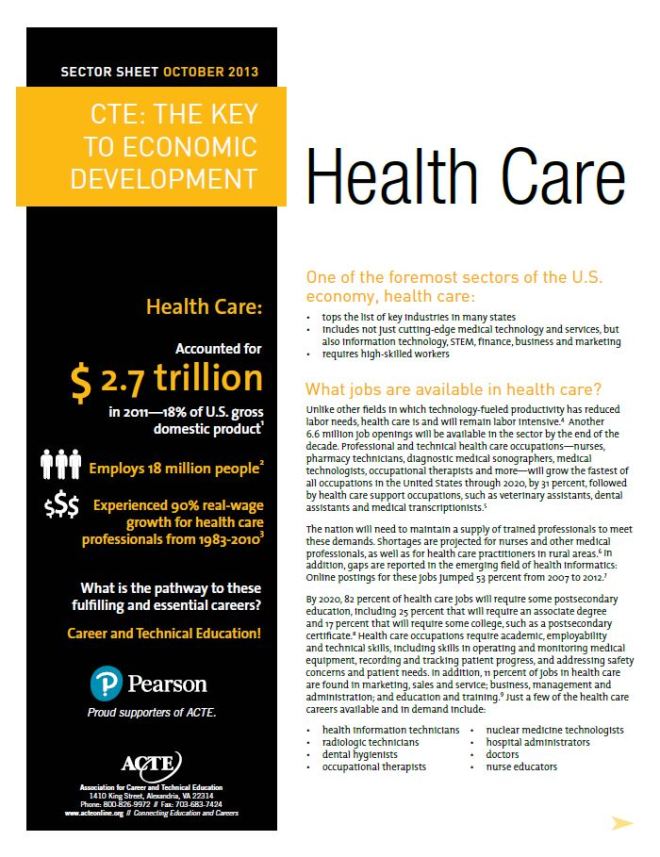
ACTE Sector Sheet: Health Care

healthsectorworksheet
Sector Sheets describe Career and Technical Education’s (CTE) role in growing the qualified workforce for vital industry sectors. Share these advocacy tools with industry, education leaders, policymakers and the public to illustrate how CTE supports specific industries and prepares students for career success.To obtain this sector sheet in health or sector sheets for other industries, click here.

Source: Association for Career and Technical Education


Workforce Wednesday: Apprenticeships in Alaska

Did you know there are over 300 apprenticeship programs right here in Alaska? If you’re looking to earn while you learn, an apprenticeship could be right up your alley.

You’ll need to know exactly which career or industry you want to work in. There are careers in mining, gas, oil, healthcare and more.

“You just don’t just show up on the doorstep of apprenticeship unprepared,” said Gerry Andrews, who works with the Department of Labor.

It’s a good idea to start preparing as soon you can. The starting pay isn’t bad, either — around $15 and hour in most industries.

If you’re interested, you can head over the Alaska Process Industry Careers Consortium website, or to the Department of Labor website.

Source: Workforce Wednesday: Apprenticeships in Alaska – KTVA 11

Alaska Wins One Million Dollar Grant to Expand Registered Apprenticeships in Health Care and Aviation

The U.S. Department of Labor has awarded a competitive grant of $1,019,985 to the Alaska Department of Labor and Workforce Development to train Alaskans for careers in the health care and aviation industries. The training will utilize Registered Apprenticeships, which are employer driven workforce development programs that combine structured on the job training with technical classroom instruction.

Registered Apprenticeships supported by the grant include Community Health Worker, Medical Administrative Assistant, Clinical Medical Assistant, Medical Biller/Coder, Commercial Pilot, Airframe and Power Plant Mechanic, and Aircraft Dispatcher. The apprenticeships will be accessible statewide, with strong participation from air carriers and primary care clinics serving rural villages and hub communities, in addition to Alaska’s urban centers.

“Registered Apprenticeship programs directly contribute to higher rates of Alaska Hire and lower rates of unemployment by increasing the supply of trained workers,” said Labor Commissioner Heidi Drygas. “Thank you to the Alaska Primary Care Association and Alaska Air Carriers Association members who are stepping up to expand training and job opportunities for Alaskans.”

The grant represents the most recent milestone in a comprehensive state effort to expand apprenticeships and increase Alaska Hire. Already, the state has re-established Alaska Hire requirements, expanded apprenticeship utilization targets for state-funded projects, and obtained federal funding to help health care providers form a multi-employer sponsor of health care apprenticeships. The $1 million ApprenticeshipUSA grant will build on that progress, as the Alaska Primary Care Association’s apprenticeships will be housed in the multi-employer Alaska Health Care Apprenticeship Consortium.

Source: Alaska Department of Labor & Workforce Development Press Release – October 24, 2016