UAF School of Education to ensure graduates are prepared for distance learning

FAIRBANKS, Alaska (KTVF) The Greater Fairbanks Chamber of Commerce continues to conduct its weekly business luncheons online. Tuesday’s topic: preparing teachers for Alaska’s future at the University of Alaska Fairbanks School of Education.

School of Education director at UAF, Amy Vinlove, discussed initiatives for the program, including recruiting and supporting Alaska Native students pursuing teaching degrees.

“We are currently at the mid-point in a nine [to] 10-year grant partnership, with some external funding from a philanthropic organization, to really try to build up those strategies and those support systems and consolidate them,” Vinlove said. “This has been area where UAF has been on the forefront for almost 50 years.”

Adapting to the changing times was a topic as well. The school of education is looking to better prepare their graduates for distance learning, as many teachers and students are experiencing right now through digital and assignment-based activities.

Read the article here.

Source: UAF School of Education to ensure graduates are prepared for distance learning – KTVF

Building community, contribution and care in the time of COVID

Jim Johnsen

The University of Alaska has demonstrated resilience and resolve over many years and across many challenging issues. Alaskans support the university in helping our students, employing our graduates, providing generous contributions, and offering their time and expertise on advisory and governing boards. This partnership with our state is highlighted by how the university is giving back to help our communities and our state during the COVID-19 pandemic.

I continue to be impressed by how our faculty, students, and staff collaborate, support one another, and conduct innovative and meaningful work. I am proud to be a part of a university system that serves our communities and our state as we work daily to build a stronger, more resilient Alaska. I believe it is UA’s responsibility to examine both current and far-reaching impacts of the current crisis and to help identify solutions.

Read the full article here.

Source: Building community, contribution and care in the time of COVID – Anchorage Press

Sen. Lisa Murkowski visits University of Alaska maritime training center

Sen. Murkowski tours UAS Ketchikan Maritime Center Welding Lab.

Republican Sen. Lisa Murkowski last month toured the University of Alaska Southeast Maritime Training Center, which has been training mariners for more than 30 years, in support of the maritime industry.

The center is located on the water in Ketchikan and includes a welding lab, navigation simulator, and diesel and electronics labs.

Murkowski expressed support for Alaska’s maritime industry when she visited, thanking faculty members for providing “valuable training opportunities for Alaskans,” the university said in a statement.

With more than 70,000 workers in the state’s maritime industry, nearly all Alaskans depend in some way on the maritime economy, the senator said.

The state is highly dependent on shipping for imports of food and other goods, as well as exports for oil, seafood and minerals.

Alaska’s economy is also dependent upon water transportation, bringing visitors on cruise ships, managing ports and harbors, traveling on the Alaska Marine Highway ferry system, and maintaining the equipment and machinery essential to villages, towns and cities.

Through the Maritime Training Center, students can advance from deckhand to third mate, preparing to handle responsibilities of limited-tonnage vessels and take on duties of an officer or owner.

The Qualified Member of the Engine Department credential offers students additional opportunities to advance in the maritime industry.

‘Dual Enrollment in Alaska’ Analysis Shows Progress and Supports Next Steps

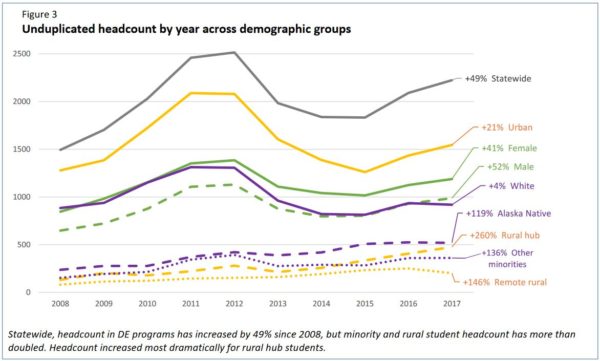
Dual enrollment programs provide access to college-level courses to high school students prior to graduation, often helping students become more successful in high school and easing their path to college. Between 2008 and 2017, University of Alaska (UA) dual enrollment programs experienced an 85 percent increase in student enrollment and, among those who graduated from high school, 41 percent went on to attend a UA institution within a year.

The new report, Dual Enrollment in Alaska: A 10-year retrospective and outcome analysis, by Dayna DeFeo, director of ISER’s Center for Alaska Education Policy Research, and Trang Tran, ISER Research Professional, looks at 10 years of UA enrollment records for dual enrollment (DE) offerings and includes 15,473 students who attended Alaska public neighborhood schools. The study provides an overview of dual enrollment – including types of programs, participation, and performance – and highlights opportunities to build on the current successes.

Source: ‘Dual Enrollment in Alaska’ analysis shows progress and supports next steps – Green & Gold News

UAS Student Becomes First to Benefit from Coast Guard Scholarship Program

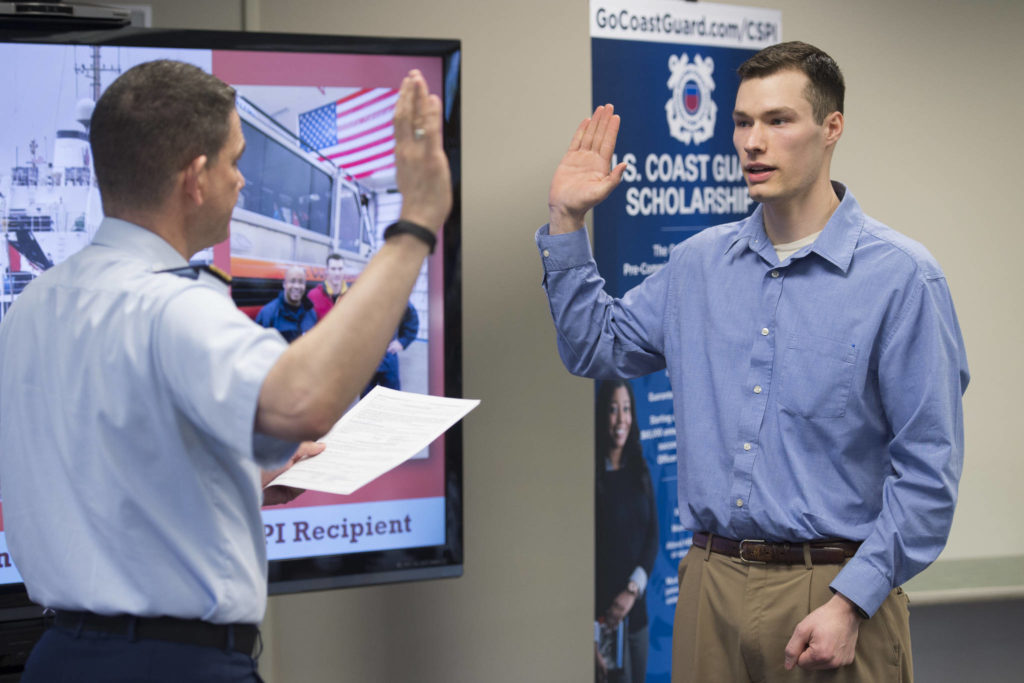
Logan Holt, 21, a business major at the University of Alaska Southeast, is sworn into the U.S. Coast Guard by Rear Admiral Matthew Bell Jr., commander of the 17th Coast Guard District, at UAS on Tuesday, April 9, 2019. Holt is the first recruit from UAS to be accepted into the Coast Guard’s College Student Pre-Commissioning Initiative program. (Michael Penn | Juneau Empire)

It took a mad dash, but Logan Holt is the first-ever University of Alaska student to be part of a new Coast Guard scholarship program at the university.

Holt, 21, formerly a home-schooled student, officially signed paperwork to be a recipient of the U.S. Coast Guard College Student Pre-Commissioning Initiative Tuesday afternoon during a swearing-in ceremony at UAS.

“It was kind of a scramble and a last-minute deal,” Holt said of his application process. “By the time I finally found out about the deadline to the time the application had to be in, I think I had eight days. This will be an exciting journey.”

Holt thanked the Coast Guard and UAS for the opportunity during the ceremony and afterward said it generally takes months to apply for programs like CSPI.

CSPI is a scholarship program meant for students between the ages of 19 and 28 with at least a 2.5 grade-point average in their sophomore or junior years of undergraduate studies, according to the UAS website.

Per the website: The program offers up to two years of paid tuition, books and fees, approximately a $3,600 monthly salary as a Coast Guard active-duty member while attending classes as a full-time student and a guaranteed job after graduation with a starting salary of about $60,000 upon graduation and completion of Officer Candidate School.

Read the full article here.

Source: Getting a ride on a Coast Guard ‘ship | Juneau Empire