Alaska Sea Grant Hosts Free Science Symposium in Kodiak

KodScienceSymposium
Alaska Sea Grant will host the Kodiak Area Marine Science Symposium from April 18-21 at the Kodiak Harbor Convention Center. The event connects the Kodiak community to regional marine science research.

The symposium provides a forum for researchers to share their findings with other scientists and the public. It also offers an opportunity for fishermen and other residents to understand how Kodiak’s marine environment and resources function, change and affect them. In addition, the symposium can help researchers plan integrated, cooperative and community-inspired marine research.

Topics will include climate change and its effects on Alaska fisheries and seabirds, underwater archaeology, marine debris removal, socioeconomic risks of military training in the Gulf of Alaska, ocean acidification and paralytic shellfish poisoning. The subject matter will be organized thematically, with a cross-disciplinary approach to encourage dialogue among disciplines.

This is the third Kodiak symposium; it was most recently held in 2014. New this year, each session will be followed by a facilitated discussion to engage participants.

The symposium is free and open to the public. An agenda and more information are available online.

Alaska Sea Grant is a statewide marine research, education and outreach program operated as a partnership between the University of Alaska Fairbanks and the National Oceanic and Atmospheric Administration. Alaska Sea Grant Marine Advisory Program agents provide assistance that helps Alaskans wisely use, conserve and enjoy marine and coastal resources.

Source: Alaska Sea Grant hosts free science symposium in Kodiak – Alaska Business Monthly

Workforce Wednesday: Careers in Behavioral Health for Rural Alaskans

The Rural Human Services program connects rural Alaskans to careers in healthcare and behavioral health. It’s a 32-credit program that is a part of the the University of Alaska Fairbanks’ Rural Academic Pipeline. The program is offered in Anchorage, Bethel and the Kuskokwim campuses.

Annie Hopper, the program’s manager, said one aspect that’s unique to the program is it blends traditional Alaska Native values with Western education. As such, elders are a vital part of the program.

Martha Peck with the Alaska Process Industry Careers Consortium said there isn’t a shortage of jobs with approximately 171 clinics in rural Alaska. Those jobs include village-based counselors and prevention workers. Job seekers can expect a pay range from $15-$30 an hour, depending on education and experience. Hopper added that employees are needed throughout the state.

For more information on the Rural Human Services program and how to get started, head to its website. To learn about Alaska Process Industry Careers Consortium, visit their website.

Watch the full video segment here.

Source: Workforce Wednesday: Careers in behavioral health for rural Alaskans | KTVA 11

Workforce Wednesday: Becoming a Power Dispatcher

Power dispatchers are the people who help keep the lights on for Alaskans from Anchorage to Cooper Landing. According to Mike Miller, a power dispatcher with Chugach Electric Association, they even forecast energy usage for customers during special events like the Super Bowl. A power dispatcher makes sure there is a stable power grid so those Alaskans can reliably get electricity. Miller said in the event of an outage, a dispatcher will coordinate with crews working in the field so power can be restored quickly and safely.

Cari-Ann Carty with Alaska Process Industry Careers Consortium said there’s a lot of career opportunities for a power dispatcher as most major communities in Alaska have a power utility company. Carty mentioned two ways to start a career as a power dispatcher. The first is to get a degree in electrical engineering like Miller. The other way is getting an internship or apprenticeship program through the International Brotherhood of Electrical Workers. The pay ranges from $25 to $55 an hour.

For more information on becoming a power dispatcher and to see who’s hiring, head to APICC.org.

Watch the full Workforce Wednesday segment here.

Source: Workforce Wednesday: Becoming a power dispatcher | KTVA 11

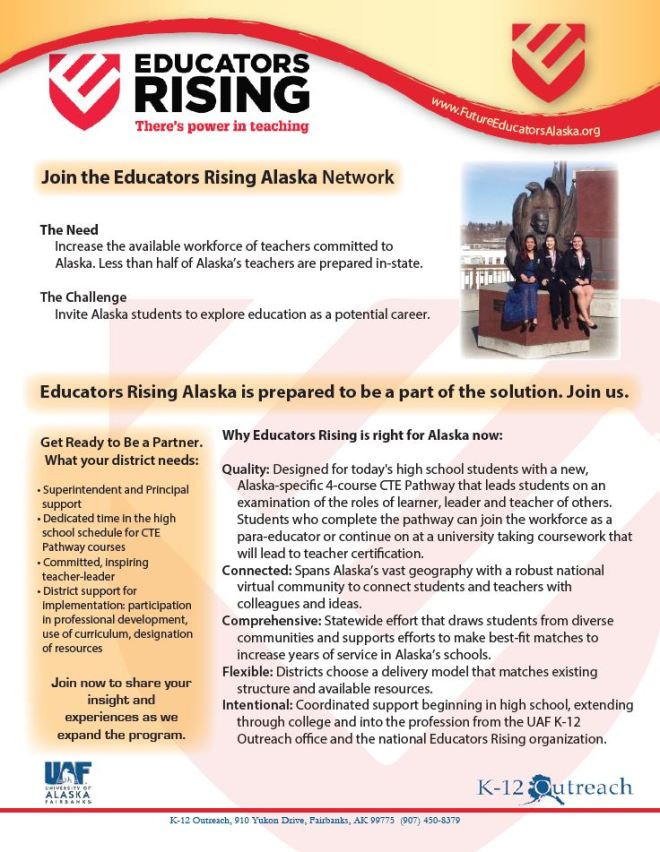
Join the Educators Rising Alaska Network

EdRising

Click the image to download the flyer and learn more at http://www.futureeducatorsalaska.org/.

Source: Future Educators of Alaska – University of Alaska Fairbanks K-12 Outreach

Aeronautics in the Far North: Success of Poker Flat, Unmanned Aircraft Program Benefits Alaska

The University of Alaska Fairbanks’ Poker Flat Research Range closed out its launch season earlier this month with a bang — three of them, to be precise. Early in the morning of March 2, three Black Brant IX sounding rockets streaked into the ionosphere, carrying instruments to study the aurora borealis’ visible structure and the formation of auroral “jets” caused by Earth’s magnetic field. In the almost 50 years since its founding, Poker Flat has been a consistent driver for UAF research, a vehicle for advances in atmospheric science and one of the university’s biggest success stories.

Launch seasons at the facility take place from January to March and usually see a handful of rockets fly each year. This year, there were five, with four of them clustered in late February and early March. The range plays a big part in UAF’s space research efforts as well as NASA’s near-Earth space science. At its humble beginnings, the future success of the range would have been hard to predict.

Read the full article here.

Source: Aeronautics in the far north: Success of Poker Flat, unmanned aircraft program benefits Alaska | Editorials | newsminer.com