Skilled Workers: The Backbone of Our Communities and Our Economy

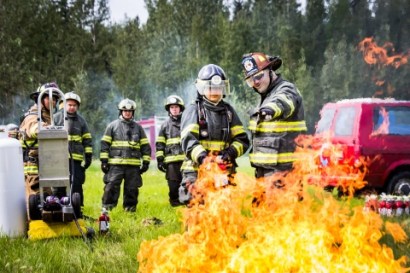
Photo courtesy of UAF Community and Technical College

Throughout the course of our daily lives we depend on the skills and services of others. From bookkeepers, nursing aides, and security personnel to welders, small engine repair, and heavy equipment mechanics, Alaska thrives when there is a dedicated workforce that serves our communities.

You may be surprised to learn that these jobs require some form of post-secondary training, which can be earned through the University of Alaska (UA), now at a reduced tuition rate.

UA is cutting tuition on select occupational programs and career and technical education (CTE) courses by 25 percent. The discount applies to 50 programs and more than 300 courses at all three universities including community campuses. Eligible programs range from pharmacy technology to welding and mine mechanics; many courses can be taken online to accommodate employed Alaskans looking to refresh skills or embark on a new career.

The university is the No. 1 provider of workforce development programs in the state, and training a skilled workforce to meet the state’s needs is one of UA’s top goals. While UA’s tuition is low compared to peer universities in the western United States, its tuition for CTE programs has been considered to be high compared to community college systems Outside.

Read the full article here.
Source: Michele Stalder – Alaska Business Magazine

Alaska Teacher to Join International Arctic Research Expedition


moira_ship-547x600
Photo courtesy of Moira O’Malley
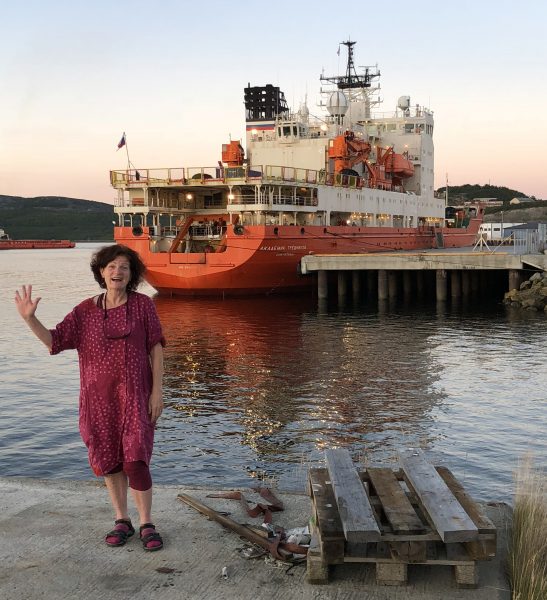
Fairbanks teacher Moira O’Malley poses in front of the Arctic research ship Akademik Tryoshnikov, which she will live on for the next 55 days.

Oceanographers at the University of Alaska Fairbanks International Arctic Research Center embark this week for a 55-day research expedition in the eastern Arctic Ocean. This year, Fairbanks elementary school teacher Moira O’Malley will join the team.

“I am ecstatic about this opportunity,” O’Malley said.

O’Malley will write a daily blog, providing updates that are exciting, fun, and written to get youth interested and involved in Arctic research. Her second-graders at Watershed School in Fairbanks will be among many Alaska students and educators following along. Once a week, students will get to ask O’Malley questions about research and life on a 438-foot scientific vessel, the Akademik Tryoshnikov.

Source: Alaska teacher to join international Arctic research expedition – UAF News and Information

New Alaska College of Education Talk of the Town on Talk of Alaska

“It’s (the middle of) summer, but students seeking higher education are making plans for fall. The university’s new Alaska College of Education aims to train more state residents to take teaching jobs here. The idea is to keep good teachers in rural Alaska communities.”

So began a round-robin discussion on July 24, when President Jim Johnsen and College of Education Executive Dean Steve Atwater joined host Lori Townsend on Alaska Public Radio Network’s Talk of Alaska to discuss the university’s goal to recruit and educate more teachers. The discussion also included Kameron Perez-Verdia, president/CEO of Alaska Humanities Forum.

“What precipitated [the Alaska College of Education] was the regents’ recognition that this is a critically important issue and our challenges…You are looking at the single most important job in our state,” Johnsen said.

Alaska faces a range of obstacles as the university endeavors to educate more Alaska teachers. Currently 70 percent of teachers hired each year for Alaska school districts come from outside the state and turnover, especially in rural Alaska, is as high as 50 percent annually. Teachers who come to rural Alaska from outside the state are often unprepared to understand cultural differences and infrastructure challenges, and the effects of decades of trauma from forced assimilation and abuse of Alaska Native students in schools are still present. The effects of these obstacles are costly, both in the financial cost of constant teacher recruitment and the impact to students who witness teachers regularly cycling in and out of their schools.

Read the full article here.

Source: The Statewide Voice

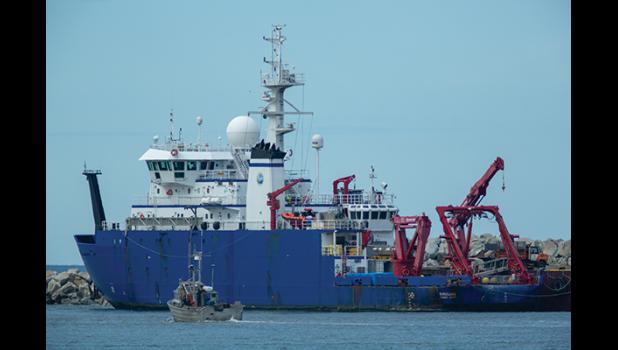
UAF Research Vessel Sikuliaq Visits Nome

Photo by James Mason
R./V Sikuliaq arrived in Nome on June 24, after its first cruise.

The research vessel Sikuliaq made port in Nome in late June after a cruise, which began in Seward on May 31. The scientists on board have been doing research in the Bering Strait area and the southern Chukchi Sea. As part of the Strait Science lecture series at UAF’s Northwest Campus, senior scientist Seth Danielson gave a talk on the vessel’s voyage and the nature of its mission.

“This project is part of a multi-year program that’s funded primarily by the North Pacific Research Board,” said Danielson, the chief scientist aboard the vessel. “It’s called the Arctic Integrated Ecosystem Research Program. Our particular project within this program is called the Arctic Shelf Growth, Advection, Respiration and Deposition, Rate Measurement Project. ASGARD for short. In Norse mythology ASGARD is the homeland of the gods and it’s the most productive of all those homelands.”

The continental shelf in the Bering Strait region is remarkable in that it gets the biggest flux of nutrients of any inner continental shelf anywhere. “There’s a massive stream of nutrients that’s coming up from the Gulf of Anadyr, we call it Anadyr water, and it flows north into the Arctic Ocean through the Bering Strait closing the global freshwater balance,” said Danielson. Excess fresh water from the North Pacific goes through the Bering Strait and makes its way to the North Atlantic, where the ocean is saltier.

Read the full article here.

Source: UAF Research Vessel Sikuliaq Visits Nome – The Nome Nugget


FAA and UAF Spark Interest in Drones at Camp

Matthew Westhoff, a pilot with UAF’s ACUASI, teaches students about drones at a camp in June. Photo by Patty Eagan.

Twenty-one middle school students built, learned how to operate and took home their own small unmanned aircraft at a camp taught by pilots and engineers from the University of Alaska Fairbanks Geophysical Institute the week of June 11-15.

The camp, funded by the Federal Aviation Administration, uses unmanned aircraft to encourage kids to pursue science, technology, engineering and math-related education and careers.

Pilots and engineers from UAF’s Alaska Center for Unmanned Aircraft Systems Integration instructed the students through a combination of engineering, flying and interacting with simulators. The students spent the week building their own unmanned aircraft, piece by piece, and flying them. They listened to presentations from industry guest speakers and learned about topics like no-fly zones and the importance of registration.

The goal was for kids to leave with technical skills and a well-rounded knowledge of not only the UAS industry but also FAA safety rules and other requirements.

Read the full article here.

Source: Alaska Native News