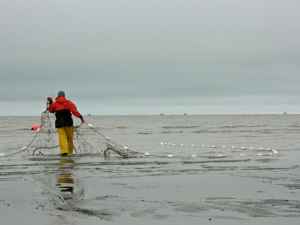
A woman sets her net in Egegik, Alaska. Photo by Amy Brown/Alaska Marine Conservation Council
Alaska Sea Grant-supported researchers won a national award at Sea Grant Week in Portland, Ore., this month for a study on how to boost access to Alaska commercial fisheries by young and rural residents.
The Sea Grant Association, comprised of Sea Grant program directors from 33 coastal universities, presented its Research to Application award to ASG director Heather Brandon who accepted it on behalf of the investigators for the project entitled, Graying of the Fleet in Alaska’s Fisheries: Defining the Problem and Assessing the Alternatives.
Sikuliaq pulls into Seward before departing for the Northern Gulf of Alaska Long-term Ecological Research cruise in May. Photo by Sarah Spanos
Editor’s note: New funding and the use of the research vessel Sikuliaq have revolutionized data collection in the Gulf of Alaska by increasing the space and workforce available to conduct complex experiments at sea.
With 20 years of research and data to support their efforts, scientists in the Northern Gulf of Alaska Long-term Ecological Research program strive to better understand how physical processes and climate variability influence the base of the food web in the productive northern Gulf of Alaska. Led by researchers from the University of Alaska Fairbanks College of Fisheries and Ocean Sciences and their collaborators, the first LTER research expedition on Sikuliaq concluded in May 2018.
This is the first story in a four-part series documenting successes and preliminary findings from that expedition.
The Gulf of Alaska supports a diverse ecosystem that includes several commercially important fisheries, as well as culturally and economically important marine mammals and birds. All of these species are fueled by tiny organisms at the base of the food chain. Observations indicate that changes in these communities of tiny organisms are linked to climate variability, but these links are poorly understood. Researchers want to better understand these links so they can evaluate how the gulf’s fisheries and marine mammals may be impacted by changes in the environment.
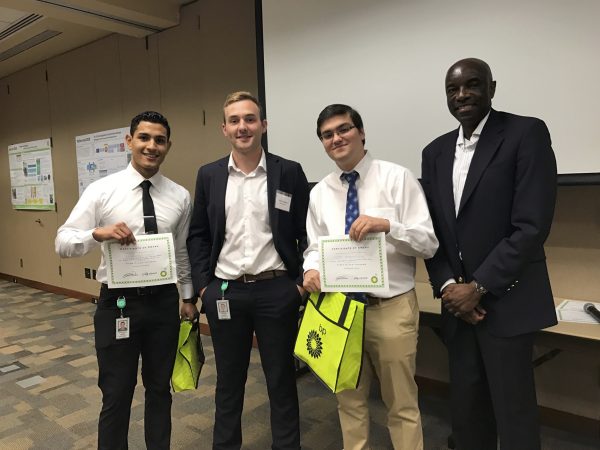
Photo courtesy of the Department of Petroleum Engineering.
For the second year in a row, UAF students from the Department of Petroleum Engineering excelled at Technofest, a competition hosted by oil and gas company BP.
Every year at BP offices around the world, challengers and interns have the opportunity to showcase their work for the wider BP community. Competitors must produce a poster to showcase a project or challenge they have been working on, and present it to a panel of judges. The competition was held in July 2018 in Anchorage.
The winners from left to right are Raymundo Lopez, Trevor Jepsen and Keith Robertson.
Photo courtesy of Cisco Werner Cisco Werner stands near the ice edge in Svalbard.
Date: September 12, 2018
Time: 4:30-5:30 p.m. Location: University of Alaska Fairbanks Murie Building auditorium
A National Oceanic and Atmospheric Administration (NOAA) chief science advisor will talk about emerging technologies for fisheries and ocean research from 4:30-5:30 p.m. Wednesday, Sept. 12, on the University of Alaska Fairbanks campus.
NOAA’s Cisco Werner will present the 2018 Fisheries and Ocean Sciences Keynote Seminar, sponsored by the UAF College of Fisheries and Ocean Sciences.
Werner’s presentation in Fairbanks will be in the Murie Building auditorium. Streaming is available at media.uaf.edu.
U.S. Secretary of Labor Alexander Acosta and U.S. Senator Dan Sullivan pose for a photo with UAF Community and Technical College students, staff, faculty and community partners in front of CTC’s downtown center. UAF photo by JR Ancheta.
On July 1, University of Alaska Fairbanks Chancellor Dan White and Community and Technical College Dean Michele Stalder welcomed U.S. Secretary of Labor Alexander Acosta and U.S. Sen. Dan Sullivan to CTC’s downtown center at 604 Barnette St. for a tour. They were also greeted by students and local job creators.
Along the tour, Acosta spoke one-on-one with students, job creators, and CTC faculty and staff. He specifically recognized the variety of over 40, career-focused programs at CTC, which are essential to workforce development in Alaska.




 UA Workforce Development News