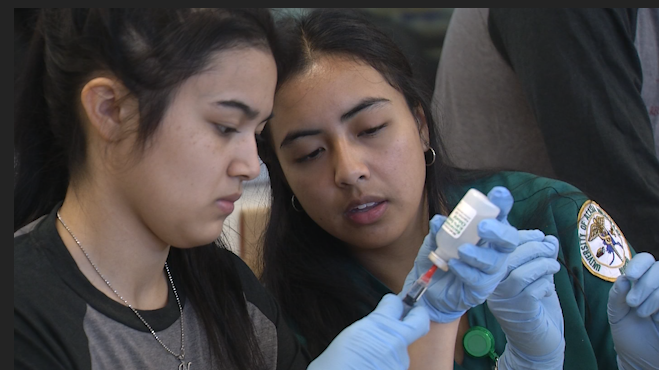
“One of the reasons why is because Alaska has what we call a ‘silver tsunami’ which is, our population is aging,” she said. “And of course, with an aging population, we have an increase in health care needs.”
Murray
said UAA is actively working to help fill the gap for health care
workers, especially nurses. The nursing school offers both a four-year bachelor’s
and two-year associate’s degree in the profession. Although,
realistically, Murray said the associate’s degree takes three years to
complete.
Many college students struggle with the balance of going to class and having to work to pay for their education. Rather than waiting until after graduation to start making money, students in the UAA Aviation Degree & Airline Pilot Employment program can now start working while finishing their education.
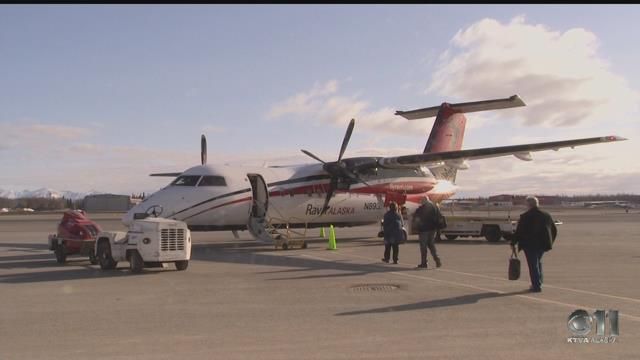
On Wednesday, UAA and Ravn Air Group announced the launch of a new program that allows students to simultaneously complete their aviation degree and work as regional airline pilots.
“The uniqueness is that the pilots come to us already qualified, but they are not yet finished with their undergraduate,” Ravn Senior Vice President of Flight Operations Deke Abbott said. “So they get credit for their undergraduate degree, while at the same time earning a living as a new commercial pilot.”
The program is a win-win for Ravn and for the students, UAA Director of Aviation Technology Paul Herrick said.
“The employment component is the different element of this, which we are really excited about,” he said. “Because students do want to get out and start making money, and start advancing their career with an actual air carrier.”
UAA’s aviation maintenance, piloting and air traffic control programs have been in place for nearly three decades and have supplied the aviation workforce in Alaska, Herrick said.
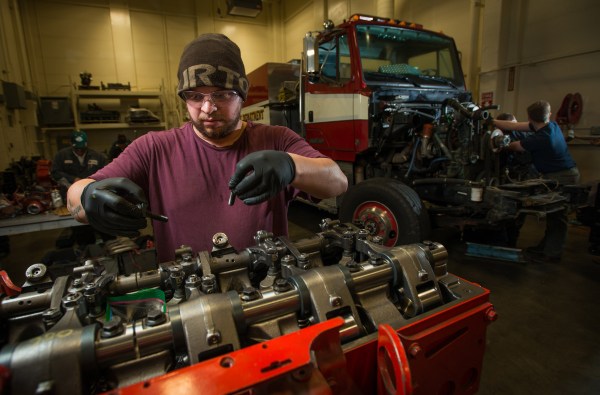
Greg Perez, a diesel power technology student, works on an engine during a fall 2017 class. (Photo by James Evans / University of Alaska Anchorage)
For the past three semesters, diesel power technology students have been busy fixing a donated fire engine in the UAA garage. So while some students claim their class projects are life-or-death, this one actually qualifies.
“Every piece has to work together perfectly or else you have a catastrophic failure,” said Ben Stewart, a diesel student who worked on the fire engine.
The stakes are high because the donated truck will return to service with the Seldovia Volunteer Fire Department. It’s a beneficial partnership: students gain valuable experience, while a small community gains a valuable emergency vehicle.
“These are great real-world projects for our students,” noted Darrin Marshall, director of the Department of Automotive and Diesel Technology.
The engine in question originally served the Anchorage Fire Department until it overheated at a rescue call. Department mechanics determined that, in a city with nearly 300,000 tax payers, it was better to replace the older engine than repair it. A community like Seldovia, though, with 0.1 percent of Anchorage’s population, would really benefit from a donation like this.
Providing early research experiences and creating supportive campus environments are among the promising and intentional strategies outlined in a new report from the National Academies of Sciences, Engineering and Medicine focused on the impact and role of minority-serving institutions (MSIs) in producing graduates in science, technology, engineering and mathematics (STEM).
Dr. Kent McGuire
The academy’s report “Minority-Serving Institutions: America’s Underutilized Resource for Strengthening the STEM Workforce” reaffirms the relevance of MSIs and notes an urgent need to invest in the institutions to not only graduate and prepare MSI students for in-demand STEM careers, but also to sustain and enhance the nation’s economic prosperity, global competitiveness and national security, according to committee members sponsoring the report.
“This country can’t strengthen the STEM pipeline and bring more people into it without engaging the institutions where the students actually are,” said Dr. Kent McGuire, co-chair of the Committee on Closing the Equity Gap: Securing Our STEM Education and Workforce Readiness Infrastructure in the Nation’s Minority-Serving Institutions. “The conversation isn’t about, ‘Well, we can’t work with these schools because they don’t have this or they don’t have that.’ The conversation has to be, ‘We won’t actually be competitive internationally if we don’t help these schools do well what it is they do.’”
McGuire, who is also program director of education at the William and Flora Hewlett Foundation, added that, among other things, the report speaks to the variation among MSIs in how they serve students and also the challenges they face collectively and individually. America’s nearly 700 two- and four-year MSIs include historically Black colleges and universities (HBCUs), Tribal colleges and universities (TCUs), Hispanic-serving institutions (HSIs) and Asian American and Native American Pacific Islander-Serving Institutions (AANAPISIs).
Read the full article here. It also mentions the Alaska Native Science and Engineering Program (ANSEP) at the University of Alaska Anchorage that embodies the strategies in the report by targeting students earlier in the pipeline – as early as sixth grade – and supporting and nurturing their intellectual growth and interest in STEM fields as they matriculate through their postsecondary education.

 UA Workforce Development News