UAA Community & Technical College Ranked Among the Best Automotive Mechanic Schools in the Nation


TheBestSchools.org just released their rankings of automotive mechanic schools and the University of Alaska Community and Technical College placed 13th in the nation.

Click here to read the full article.

#13 University of Alaska Anchorage – Community and Technical College

The University of Alaska Anchorage, the largest university in Alaska, is a public university that offers a straightforward approach to the study of automotive technology through its Community and Technical College division.

The school is career-focused, and the courses are modeled after corporate training programs, and based on ASE certification standards. It offers the unique option of the General Motors ASEP program, which specifically prepares students for automotive service career on GM vehicles, through partnering with GM dealerships. This provides strong career recruitment potential, as well as paid, on-the-job experience, and prepares students for Master ASE-certification.

The courses have small class sizes, and take a hands-on approach, allowing students to gain valuable experience with a wide variety of vehicles, working closely alongside instructors and peers.

The University of Alaska Anchorage is regionally accredited by the Northwest Commission on College and Universities (NWCCU) and its automotive programs are accredited by NATEF.

Degree Programs:

  • Associate of Applied Science – Automotive Technology with focus in General Automotive, or with focus in General Motors ASEP
  • Associate of Applied Science – Diesel Power Technology

Other Programs:

  • Certificate – Automotive Technology
  • Certificate – Diesel Power Technology

Source: The 20 Best Automotive Mechanic Schools | The Best Schools

Workforce Wednesday: Air Traffic Controllers

A career as an air traffic controller comes with high stakes and potentially high wages. According to the Alaska Department of Labor it is one of the top jobs in the state, and is projected to grow.

“The FAA is trying, nationwide, to hire between 1,300 and 1,700 controllers a year,” said Duane McQuillin, a training manager with Federal Aviation Administration.

He added that the facility he works at is looking to have 115 air traffic controllers on site. They currently have 70.

The Department of Labor reported that the median salary of an air traffic controller is around $104,000 a year, plus a cost of living adjustment of 25%. That brings the yearly income up to about $115,000.

The University of Alaska Anchorage is a good place to start on the path to becoming a controller. The Alaska Process Industry Careers Consortium and FAA website can also help with resources to get started.

McQuillin noted that for someone to be considered they would have to be United States citizen and pass various psychological and physical tests.

Click here to watch the video segment.

Source: Workforce Wednesday: Air Traffic Controllers | KTVA 11

Alaska, Reliant on Air Transit, Faces Pilot Shortage. Are Drones an Answer?

Matt Gallagher, a pilot for Warbelow’s Air, cleaning snow off a plane in subzero temperatures in Fairbanks. Credit Ruth Fremson/The New York Times

FAIRBANKS, Alaska — Never climb into an airplane cockpit in winter without your best military-grade arctic boots, rated to minus 60 degrees Fahrenheit. Green, cocky pilots fresh from the lower 48 tend to forget that rule just once. Knowing when not to climb aboard the plane at all is harder, and comes only with deeper experience.

“If my gut tells me this is not good, we don’t go,” said Matt Anderson, 55, who has spent more than 25 years flying small planes across Alaska’s wild, empty and hazardous landscapes.

Generations of pilots like Mr. Anderson once came north for adventure, and to hone their skills in small planes, flying the Alaskan bush in the nation’s most aviation-dependent state. Their derring-do, in turn, helped create the Alaskan mystique.

But now a shortage of pilots — global in scope, fueled by the growth of aviation in Asia and a wave of baby boomer retirements — is rippling across Alaska with gale force. A state with six times as many pilots per capita as the rest of the nation, and the need for every one of them to connect its many far-flung dots on the map, is rewriting the equations of supply and demand.

Read the full article here.

Source: Alaska, Reliant on Air Transit, Faces Pilot Shortage. Are Drones an Answer? – The New York Times

Workforce Wednesday: Cargo Careers at FedEx


Careers in corralling cargo is what FedEx is all about — especially at Ted Stevens Anchorage International Airport, which was the fourth-largest airport in terms of cargo in 2015, according to the Anchorage Economic Development Corporation.

The freight and transportation industry is essential in Alaska because of how many goods come through either the port or cargo planes. According to Cassie Ostrander with Alaska Process Industry Careers Consortium, the industry currently has an estimated 21,000 jobs in this sector. That number is expected to grow by 10 percent by 2024, she said.

FedEx employs more than route workers and cargo handlers. The company’s Anchorage operations administrator, Erin Smulick, said the jobs they hire for are diverse.

“We also have ramp agents that compute the weight and balance for flights. We have couriers, mechanics that do aircraft mechanics and also mechanics that do all the other equipment we have,” she said.

According to the Alaska Department of Labor, entry-level positions in the transportation and warehousing sector range from $10 to $15 an hour, later ranging to nearly $40 an hour.

FedEx prioritizes hiring and promotion from within the organization. It also offers benefits, including tuition reimbursement, 401(k), paid time off and holiday pay.

FedEx is hiring now. Applications can be found on its website.

Editor’s Note: In the video above, several locations are listed with employment opportunities with Fedex facilities. Kenai was unintentionally excluded from that list.

Correction: An earlier version of this story stated 21,000 jobs would be added to the freight and transportation industry. This has been amended.

Watch the video here.

Source: Workforce Wednesday: Cargo careers at FedEx | KTVA 11

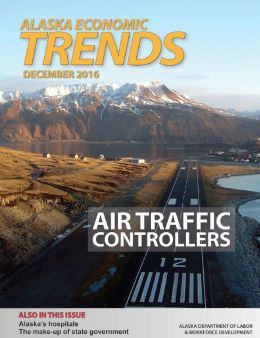
Alaska December 2016 Economic Trends – Air Traffic Controllers

december2016trendsDecember Trends examines air traffic controllers in detail. This occupation, which requires extensive training, has only modest education requirements. It’s also one of Alaska’s highest paying occupations, expected to grow about 7 percent in the next decade. This issue also profiles employment in Alaska’s hospitals and how that industry developed in the state. Finally, an analysis of the make-up of state government shows where these workers are and which departments they work for.

Source: Alaska Department of Labor and Workforce Development