University of Alaska Southeast, Dual Enrollment and Career Pathways in High Schools!

Let’s face it; many high school faculty members are overloaded with teaching core courses, so the thought of adding new curricula often brings a cringe to their faces and the beginnings of a migraine headache. What if high schools could offer new and exciting coursework without the cringing or the headaches? What if high school faculty didn’t even need to teach the content? What if all the resources (lectures, reading assignments, exams, etc.) were already available? What if students could take courses for both high school and college credit? What if it didn’t cost students money?

In spring 2017, the UAS Fisheries Technology program reinvented a way to offer courses that are:

  1. Engaging and technology-based,
  2. Use the latest educational pedagogy, and
  3. Can be delivered directly into the high school classroom with no internet required.

These courses were initially created for distribution on university supplied Apple iPads, but have since been finding their ways into many high schools throughout the state. Imagine “beaming” a college instructor directly into a high school classroom where the on-site high school faculty member is doing little more than facilitating progress through the course and fostering discussion points.

Read the full article here.

Source: Association of Alaska School Boards

Alaska Sea Grant: New Cohort of State Fellows Start Alaska-based Jobs

Photo courtesy of (left to right): Ali Schuler, Dianna Perry, Marguerite Tibbles, Kayla Schommer, and Nyssa Baechler

For the fourth year, Alaska Sea Grant has funded five graduate students to begin marine policy and science communications work with local host organizations this fall.

Modeled after the highly successful Knauss Marine Policy Fellowship, the Alaska Sea Grant State Fellowship provides recent graduates with a unique professional opportunity to work firsthand on the science and policy needed to keep Alaska’s marine resources healthy.

This year’s cohort originates from the University of Alaska Fairbanks, College of Fisheries and Ocean Sciences, and the University of Washington, School of Marine and Environmental Affairs.

Read the full article here.

Source: Alaska Sea Grant: New cohort of State Fellows start Alaska-based jobs


Alaska Sea Grant: Graying of the Fleet Research Wins National Award

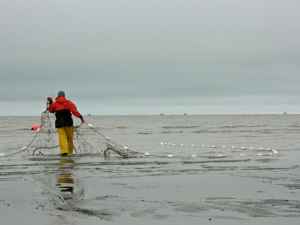
A woman sets her net in Egegik, Alaska. Photo by Amy Brown/Alaska Marine Conservation Council

Alaska Sea Grant-supported researchers won a national award at Sea Grant Week in Portland, Ore., this month for a study on how to boost access to Alaska commercial fisheries by young and rural residents.

The Sea Grant Association, comprised of Sea Grant program directors from 33 coastal universities, presented its Research to Application award to ASG director Heather Brandon who accepted it on behalf of the investigators for the project entitled, Graying of the Fleet in Alaska’s Fisheries: Defining the Problem and Assessing the Alternatives.

Source: Alaska Sea Grant: Graying of the Fleet research wins national award – Sea Grant Alaska

Research Vessel Sikuliaq Expands Ways to Study Gulf of Alaska Ecosystems

Sikuliaq pulls into Seward before departing for the Northern Gulf of Alaska Long-term Ecological Research cruise in May. Photo by Sarah Spanos

Editor’s note: New funding and the use of the research vessel Sikuliaq have revolutionized data collection in the Gulf of Alaska by increasing the space and workforce available to conduct complex experiments at sea.

With 20 years of research and data to support their efforts, scientists in the Northern Gulf of Alaska Long-term Ecological Research program strive to better understand how physical processes and climate variability influence the base of the food web in the productive northern Gulf of Alaska. Led by researchers from the University of Alaska Fairbanks College of Fisheries and Ocean Sciences and their collaborators, the first LTER research expedition on Sikuliaq concluded in May 2018.

This is the first story in a four-part series documenting successes and preliminary findings from that expedition.

The Gulf of Alaska supports a diverse ecosystem that includes several commercially important fisheries, as well as culturally and economically important marine mammals and birds. All of these species are fueled by tiny organisms at the base of the food chain. Observations indicate that changes in these communities of tiny organisms are linked to climate variability, but these links are poorly understood. Researchers want to better understand these links so they can evaluate how the gulf’s fisheries and marine mammals may be impacted by changes in the environment.

Read the full article here.

Source: Research vessel Sikuliaq expands ways to study Gulf of Alaska ecosystems – News Miner

Werner to Discuss Fisheries and Ocean Research Technology

Photo courtesy of Cisco Werner
Cisco Werner stands near the ice edge in Svalbard.
Time: 4:30-5:30 p.m.
Location: University of Alaska Fairbanks Murie Building auditorium

A National Oceanic and Atmospheric Administration (NOAA) chief science advisor will talk about emerging technologies for fisheries and ocean research from 4:30-5:30 p.m. Wednesday, Sept. 12, on the University of Alaska Fairbanks campus.

NOAA’s Cisco Werner will present the 2018 Fisheries and Ocean Sciences Keynote Seminar, sponsored by the UAF College of Fisheries and Ocean Sciences.

Werner’s presentation in Fairbanks will be in the Murie Building auditorium. Streaming is available at media.uaf.edu.

Source: Werner to discuss fisheries and ocean research technology – UAF Cornerstone