At Alaska Middle College School Students an Earn a High School Diploma and Associate’s Degree at the Same Time

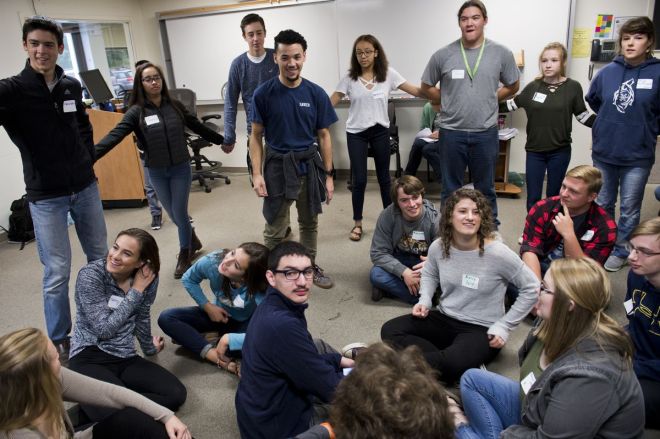
Zavier Alers, standing near center in a blue T-shirt, leads an icebreaker exercise for students of Alaska Middle College School on Aug. 21, 2017. (Marc Lester / Alaska Dispatch News)

Monday marked the first day of school for tens of thousands of Anchorage students and the first day of the school district’s latest program: the Alaska Middle College School, where students can earn an associate’s degree and high school diploma at the same time, at no cost to them.

About 140 Anchorage high school juniors and seniors have enrolled in the middle college and on Monday morning, they split into five classrooms at the University of Alaska Anchorage Chugiak-Eagle River Campus to meet one another and attend lessons on how college works.

“There’s a lot more independence in your future,” Teacher David Maker told one group of teenagers. “You’re not going to have the amount of babysitting you’ve had the past two years.”

For the remainder of the week, the high school students will attend “boot camp” classes before they’re thrust into UAA lectures with university students.

“They’re university students, they have a university ID badge,” said Anchorage School District Superintendent Deena Bishop. “We’re not turning the university into high school, high school is stepping up the game.”

While the middle college students will attend regular university-level classes, they will also have access to two high school teachers who will hold “support seminars” in the building to review material, said Kathy Moffitt, ASD’s administrative projects director.

Read the full article here.

Source: At Alaska Middle College School, students can earn a high school diploma and associate’s degree at the same time – Alaska Dispatch News

Workforce Wednesday: Educator with the Dept. of Corrections

The Department of Corrections (DOC) is looking for Education Coordinators and Vocational Instructors. Gary Olsen, Criminal Justice Planner of Education with the DOC, joined Daybreak Wednesday to provide details.

Vocational instructors primarily teach the construction trade: electrical, carpentry, plumbing and HVAC skills. They use the curriculum in the National Center for Construction Education and Research that is sponsored by Alaska Process Industry Career Consortium (APICC). Prisoners build a small house in the vocational trade area, getting a resume‑building certification that will help them get jobs after incarceration.

The DOC is seeking applicants with a minimum of three years as a journeyman in construction. They also consider the kinds of experience that someone has supervising crews. Applicants should have a great attitude, an ability to follow rules, policies, procedures, and classroom direction skills.

Education Coordinators perform more traditional teacher duties. They teach criminal attitudes programs, re-entry, anger management, and GED classes. The minimum qualification for this position is a bachelor’s degree in psychology, counseling, or education. Many veterans find themselves successful in this position, Olsen says, because the experience obtained while serving is excellent preparation for teaching at the DOC.

These positions yield roughly $4,000 a month. Health coverage includes eye, dental, and medical care. The state also provides a small stipend for retirement.

More positions are potentially expected to open in the future. For full descriptions, visit governmentjobs.com/careers/alaska.

For help beginning a career in the positions covered in Workforce Wednesday, contact Martha Peck with APICC at (907) 770-5250 or martha@apicc.org.

Watch the full Workforce Wednesday video segment here.

Source: Workforce Wednesday: Educator with the Dept. of Corrections » KTVA 11

Alaska March Economic Trends

March2017TrendsMarch Trends is an in-depth look at the gender wage gap Alaska, including by region, industry, occupation, age, and educational level. Including part-time workers, women make an average of 68 percent of what men make in Alaska. Also this month is an analysis of educational attainment levels in Alaska since the territorial days and how the state compares to the nation. Overall, educational levels in both Alaska and the U.S. have been rising for the past 75 years, but the patterns have differed by region and demographic group.

Click here to read March Trends.

Source: Alaska Department of Labor and Workforce Development


Alaska’s Education Challenge – Office of the Governor

JUNEAU – Alaskans are encouraged to express their priorities for public education reform in a new online survey at https://gov.alaska.gov/education-challenge.

The survey is the first step in the State Board of Education’s participatory process to meet Governor Bill Walker’s Alaska Education Challenge: to establish an efficient, sustainable, and comprehensive system that will provide an excellent education for every student every day.

On Jan. 18, 2017, in his State of the State address, Governor Walker said, “We must do a better job of preparing our youth for the challenges of the future. To meet this challenge, we need to rethink our entire system of public education. Alaskans must be at the heart of this effort.”

The ultimate goal is to graduate students ready for career training and college, whether in the workforce, the military, apprenticeships, technical education courses, or associate degree and bachelor’s degree programs.

“Alaska faces obstacles to student achievement unlike those that exist in any other state in the nation. Alaska’s Education Challenge is to address our student achievement gaps and increase our graduation rate by making sure every student across our state has an equal opportunity to learn and succeed,” said Dr. Michael Johnson, Alaska Commissioner of Education. “Our students, their families, and teachers deserve a focused effort to support the public education system through reform. Though many students in our state are getting a very good education, a large and tragic achievement gap exists.”

The State Board of Education will lead a process of listening, gathering input, and reporting information that will shape recommendations to improve Alaska’s public schools. The board will present its final report to the Governor and Legislature by Dec. 29, 2017.

Commissioner Johnson will establish five committees to gather input from a broad range of Alaskans regarding: 1) student learning, 2) educator excellence, 3) modernization and finance, 4) tribal and community ownership, and 5) safety and well-being.

Students, parents, educators, business leaders, tribal representatives, community leaders, and legislators will be invited to serve on the committees, co-chaired by members of the State Board of Education.

The public will be able to follow the process and participate through the Alaska Education Challenge website: https://gov.alaska.gov/education-challenge. All meetings will be open to the public, and meeting documents will be made available online.

“There have been well-meaning efforts in the past to improve our schools,” said James Fields, chair of the State Board of Education. “What will distinguish the Alaska Education Challenge is its comprehensive analysis, well-publicized opportunities for public participation, and strong support from the Governor.”

Source: Alaska’s Education Challenge – Office of the Governor

UAA Alaska Native Studies & Elementary Education Student Appreciates and Shares His Culture

Byron Nicholai’s videos of his Yup’ik singing, dancing and drumming have cultivated and inspired a devoted following on Facebook. Now, he’s a UAA elementary education student and has performed for the President of the United States.

To read the full article, click here.

Source: UAA Green & Gold News