Rob Keiger, economist with the Alaska Dept. of Labor and Workforce Development, details why homes in Alaska are still selling — the market is by no means stalling —with limited inventory and affordability pushing prospective homebuyers out of the market.
The May edition also features a piece on three Alaskan ghost towns, and the monthly Gauging the Economy report.
Gunner Shultz, economist with the Alaska Dept. of Labor and Workforce Development, explains what 2023 drops to inflation rates means to Alaska. Although rates decreased, this does not mean prices decreased —prices went up less than they did the year before.
The April edition also features seafood processing and closures, post-covid population trends, and the monthly Gauging the Economy report.
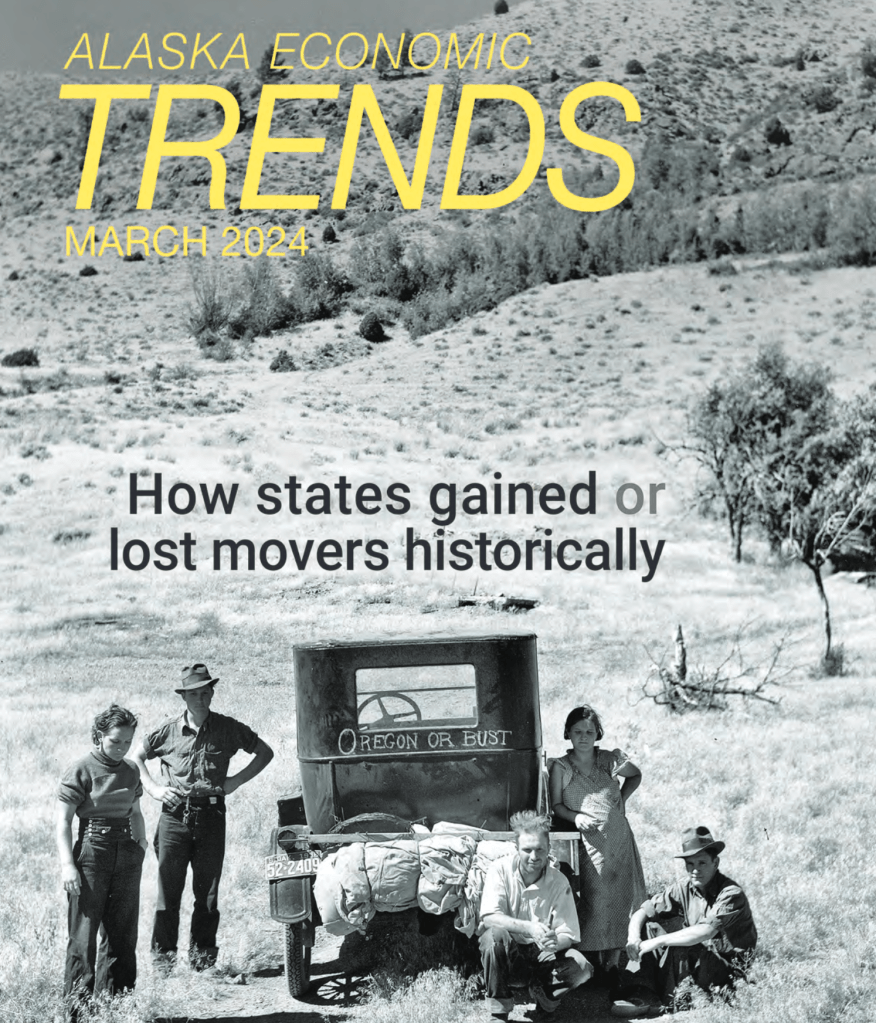
In July 1936 , Vernon Evans (center)and his family left their grasshopper-ridden and drought-stricken home in Lemmon, South Dakota, for a new start in Oregon or Washington. The family is shown here near Missoula, Mont., where they were stopped by the photographer, who worked for the Resettlement Administration. Evans said in the interview, which is recorded at livinghistoryfarm.org, that he made about 200 miles a day in his Model T Ford and they slept in a tent. The family hoped to get to Yakima, Wash., in time to pick hops. They eventually made it to Oregon, where Evans took a job with the railroad. Photo by Arthur Rothstein, archived at the Library of Congress.
Eric Sandberg of the Alaska Dept. of Labor and Workforce Development discusses Alaska’s 10+ year streak of net migration in comparison to losses among the rest of the country. Sandberg explores which states have been through similar periods of net migration losses and why, and how long they lasted.
The March edition also provides the monthly report Gauging the Economy.
Hiking in Denali National Park, photo by Cody Badger Creative Commons by nc-sa 2.0.
Rob Kreiger of the Alaska Dept. of Labor and Workforce Development discusses the significant role nonresident workers play in Alaska’s recovery from the 2020 pandemic. The number of Alaska resident workers is still bouncing back from COVID — nonresident workers have exceeded them. Kreiger highlights industries currently relying on nonresident workers and the paths these workers take to fill the state’s workforce gaps.
The February edition also provides 2022 worker residency data, and the monthly report Gauging the Economy.
This photo of a giant kelp is by Flickr user John Turnbull. Giant kelp is one of the varieties of kelp farmed in Alaska. License.
Sara Whitney of the Alaska Dept. of Labor and Workforce Development highlights Alaska’s growing aquaculture industry. Alaska has more coastline that the lower 48 combined, but only in June of this year, the state was deemed as a federal aquaculture opportunity area. This opportunity allows the state to support multiple commercial aquatic farming operations, like kelp. Although the salmon hatchery industry came first, seaweed is a newcomer with many uses, and the industry is expanding.
The December edition also highlights Alaska community changes from pre- to post-pandemic. The monthly high-level overview of Alaska’s economy closes this month’s publication.




 UA Workforce Development News