From Classroom to Career: The Value of CTE in Alaska

Alaska’s Career and Technical Education (CTE) programs equip students with essential skills that lead to high school graduation and career success. According to the Alaska Department of Education & Early Development, 98% of CTE concentrators graduate, demonstrating the impact of hands-on, skills-based learning. While only 18% of Alaskan graduates are CTE concentrators, 75% go on to postsecondary education, advanced training, military service, or employment, reinforcing the value of these pathways in building a skilled workforce.

CTE also promotes economic mobility and inclusivity, with 40% of participants from economically disadvantaged backgrounds and 28% pursuing nontraditional occupations. Expanding access to these programs ensures more students gain the skills needed to thrive in Alaska’s evolving job market, strengthening both individual success and the state’s economy.

To explore the full infographic, download it here.

If you would like an infographic specific to your district, please contact Bjorn (bjorn.wolter@alaska.gov) directly to request it.  Please allow one to two weeks for creation.  

Source: Alaska Department of Education and Early Development.

CTC receives $4.3 million to boost Native student success

UAF photo by Leif Van Cise. UAF Community and Technical College has received a $4.3 million federal Title III grant from the U.S. Department of Education to improve access and success for Alaska Native students.

The University of Alaska Fairbanks’ Community and Technical College has been awarded a $4.3 million federal Title III grant from the U.S. Department of Education. The five-year grant will be used to enhance academic programs, student services and partnerships with industry to improve access and success for Alaska Native students.

This is the first time in UAF’s history that CTC has been eligible for Title III funding, reflecting the growing interest from rural communities and Alaska Native students in our diverse portfolio of workforce programs.

Bryan Uher, UAF associate vice chancellor for community and workforce education

Read the full announcement here.

Source: Kari Halverson, Communications & Publications Coordinator. UAF news and information.

UAA’s Aviation Program Awarded $50,000 in Scholarships from Atlas Air Worldwide

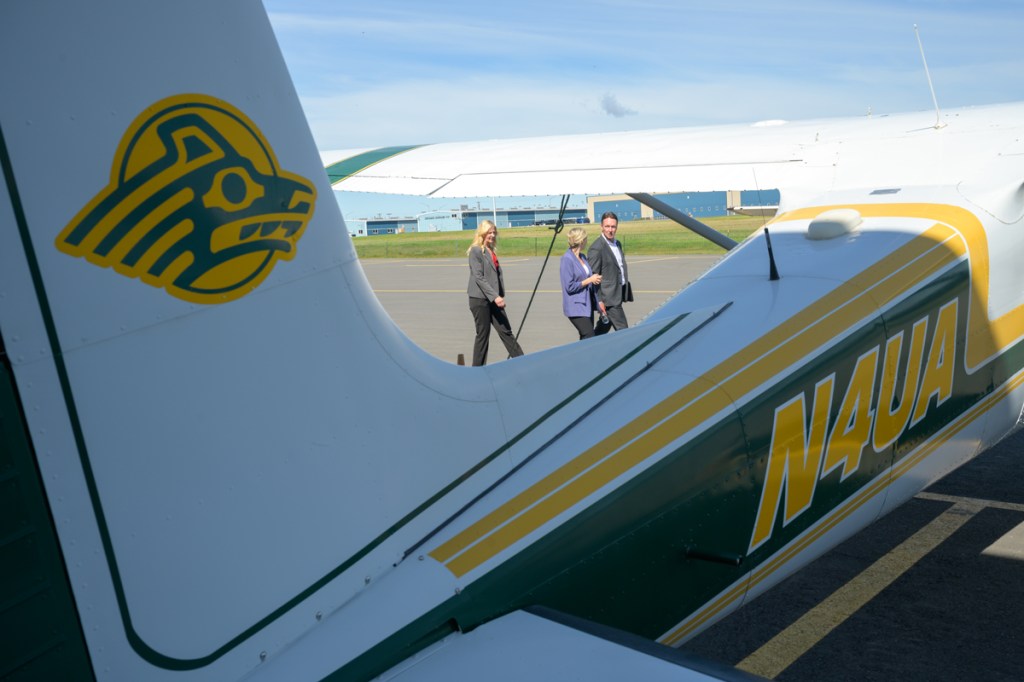
Atlas Air CEO Michael Steen tours the flight line with UAA Piloting and Aviation Management Professor Cassie Martin and Chief Strategic Gifts Officer Jennifer Motes as he visits UAA’s Aviation Technology Center. (Photo by James Evans / University of Alaska Anchorage)

Atlas Air Worldwide Holdings Inc., a leading global provider of outsourced aviation logistics, announced today that it will award $50,000 in scholarships to the University of Alaska Anchorage. The needs-based scholarships will help offset education costs for students pursuing careers in the aviation industry. The award will include four $5,000 scholarships for students pursuing careers as aviation maintenance technicians and three $10,000 scholarships for those aspiring to become pilots.

This scholarship is going to have a profound impact on our program, improving our students’ ability to get through the program on time. So many of our students work full-time jobs trying to make ends meet and pay tuition. With support from Atlas Air, our students will get through the program quickly with a high level of skill, knowledge and preparation to work in Alaska.

Ray Weber, Dean of UAA Community and Technical College

Read the full announcement here.

Source: Michelle Sapport, Writer and Communications Specialist. University of Alaska Anchorage Advancement.

Governor Dunleavy signs UA priority legislation to support student success, workforce development

Legislation containing several of the University of Alaska’s (UA) top priorities has been signed into law by Governor Dunleavy. House Bill 148 (HB148) expands the Alaska Performance Scholarship (APS), reauthorizes the Technical Vocation and Education Program (TVEP), and extends the Education Tax Credit (ETC) program. Together, the changes will help prepare and develop Alaska students for the workforce by making post-secondary education more accessible and attainable. 

All three of these programs were priorities for the university this year, and I’m very grateful to the Legislature and Governor Dunleavy for their support. UA is an economic engine that empowers Alaska. APS, TVEP, and the ETC are key programs for attracting Alaska students, providing high-quality workforce training and collaborating directly with industry to develop programs that meet their employment and research needs.

UA President Pat Pitney

Read the full article here.

Source: UA News Center, Office of Public Affairs.

Uher named associate vice chancellor of rural, workforce education

Photo UAF photo by JR Ancheta

Bryan Uher has been appointed as the new associate vice chancellor of rural, workforce education within the Rural, Community and Native Education unit. Uher will oversee the rural campuses and the Mining and Petroleum Training Service units, along with supporting UAF’s workforce and partnership development and specialized accreditations within the College of Indigenous Studies  and the Community and Technical College.

Having served as a rural campus director and as dean of both CIS (formerly the College of Rural and Community Development) and CTC, Uher has valuable insight into current and future opportunities for increased synergies across our programs and regions. His leadership will significantly strengthen and reinforce UAF’s collective capacity to serve the rural and workforce education needs across the state. 

Source: Kari Halverson, Marketing & Communications Coordinator, UAF Community & Technical College