Alaska’s Career and Technical Education (CTE) programs equip students with essential skills that lead to high school graduation and career success. According to the Alaska Department of Education & Early Development, 98% of CTE concentrators graduate, demonstrating the impact of hands-on, skills-based learning. While only 18% of Alaskan graduates are CTE concentrators, 75% go on to postsecondary education, advanced training, military service, or employment, reinforcing the value of these pathways in building a skilled workforce.
CTE also promotes economic mobility and inclusivity, with 40% of participants from economically disadvantaged backgrounds and 28% pursuing nontraditional occupations. Expanding access to these programs ensures more students gain the skills needed to thrive in Alaska’s evolving job market, strengthening both individual success and the state’s economy.
To explore the full infographic, download it here.
If you would like an infographic specific to your district, please contact Bjorn (bjorn.wolter@alaska.gov) directly to request it. Please allow one to two weeks for creation.
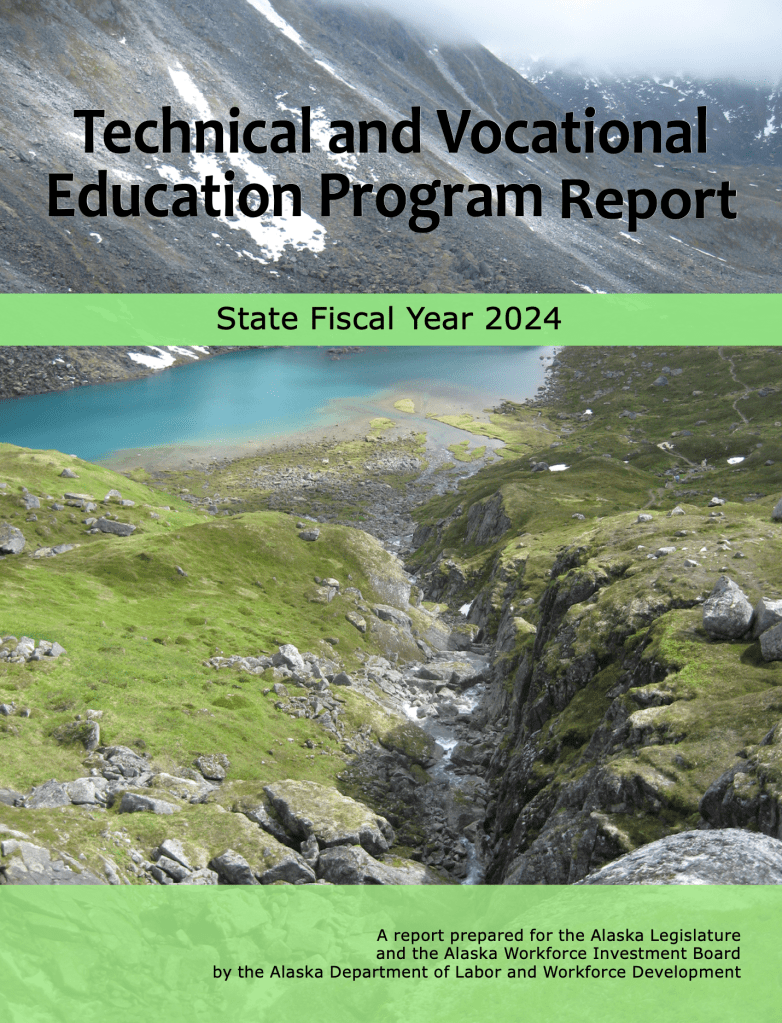
Water flows toward Lower Reed Lake, photo by Flickr user McGeez
Alaska’s economy is evolving, and so are the education and training programs designed to support it. The 2024 Technical and Vocational Education Program (TVEP) Report provides a comprehensive overview of how workforce training programs across the state are preparing Alaskans for high-demand careers.
TVEP funding plays a critical role in equipping Alaskans with the skills needed for economic resilience. This year’s report highlights the performance of training institutions while emphasizing the shifting landscape of Alaska’s workforce development — driven by regional industry needs, changing demographics, and emerging economic opportunities.
Alaska’s Workforce at a Glance
The report outlines key workforce trends across Alaska, illustrating how training efforts align with economic shifts and emerging opportunities. Some notable trends include:
Economic Diversification: Alaska is expanding beyond oil, gas, and fisheries to embrace infrastructure, tourism, and renewable energy sectors.
Vocational Training Demand: Healthcare, construction, transportation, and maritime services remain high-growth industries.
Regional Adaptations: Training programs align with regional needs, from commercial fishing in the Southwest Region to military and university-driven employment in the Interior.
Understanding these trends helps clarify why vocational training is essential for the state’s long-term prosperity. As the workforce landscape continues to evolve, training providers are stepping up to meet these changing demands.
Spotlight on the University of Alaska
The 2024 report reviews the outcomes of ten major training institutions. Among them, the University of Alaska (UA) stands out for its scale and statewide impact.
In 2024, UA received $6.26 million in TVEP funding, serving nearly 6,000 students across its campuses in Anchorage, Fairbanks, and Juneau. UA’s approach to vocational and technical education extends beyond traditional degree programs. Key highlights include:
Industry Partnerships: Collaboration with employers in oil and gas, healthcare, and engineering ensures curriculum relevance.
Expanding Online Learning: UA continues to grow its online and hybrid programs, improving access for rural students.
The Fairbanks Pipeline Training Center also received $883,000 in pass-through funding for training in construction, oil, and gas—key sectors as Alaska sees renewed pipeline infrastructure investments.
Why This Matters for Alaska
Workforce development isn’t just about filling jobs—it’s about sustaining Alaska’s economy. TVEP funding ensures industries have skilled labor while providing Alaskans with stable, well-paying careers.
The University of Alaska’s leadership in vocational training plays a crucial role in retaining talent and preparing the state’s workforce for the future. As Alaska navigates challenges like declining high school graduation rates and population outmigration, the 2024 TVEP Report makes one thing clear: investment in vocational training is investment in Alaska’s future.
By aligning training programs with industry needs and expanding access to education, Alaska is building a stronger, more resilient workforce ready to meet the challenges ahead.
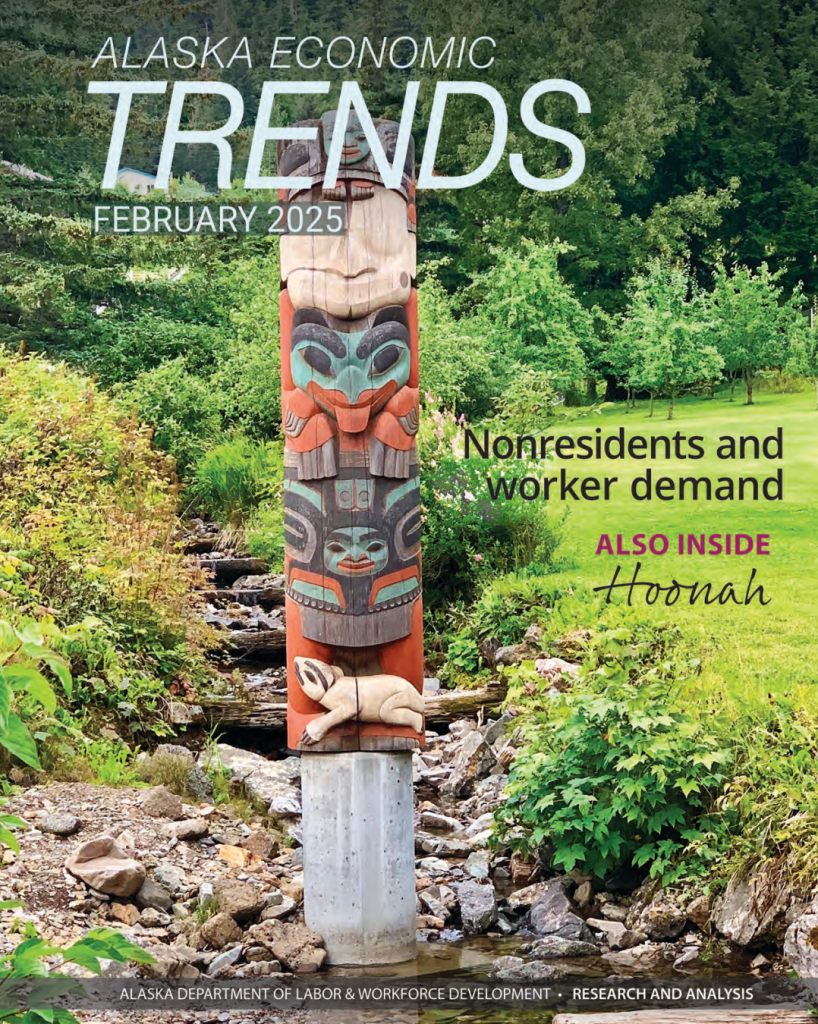
A totem pole in Hoonah, photo by Flickr user Clark Harris in Colorado. Creative Commons license BY-NC-SA 2.0.
In this month’s feature article, Rob Kreiger, economist with the Alaska Dept. of Labor and Workforce Development, examines the rise of nonresident workers across Alaska’s industries. In 2023, the number hit its highest since 1995 — nonresidents being 22.5% of the state’s workforce.
The February edition also features a piece on Hoonah, being a Southeast Alaska niche, and the monthly Gauging the Economy report.
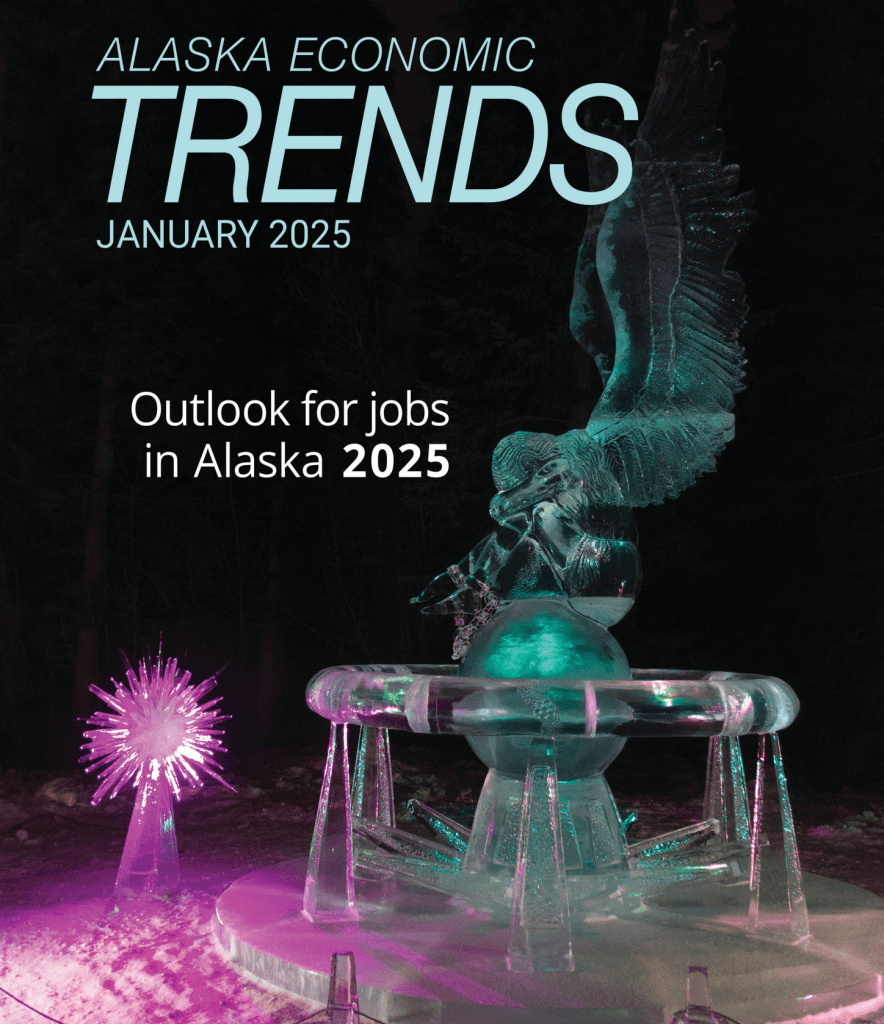
World Ice Art Championships in Fairbanks in 2016. Photo by Flickr user Iceflo. Creative Commons license BY-NC-SA 2.0.
In this month’s feature article, Karinne Wiebold, economist with the Alaska Dept. of Labor and Workforce Development, provides a forecast of the state’s 2025 job growth — steady growth is set to continue. The 2025 projections are led by the construction, health care, transportation, and oil and gas industries.
The January edition also features a piece on job forecasts specific to Anchorage, Fairbanks, and Southeast Alaska. Also featured is the monthly Gauging the Economy report.
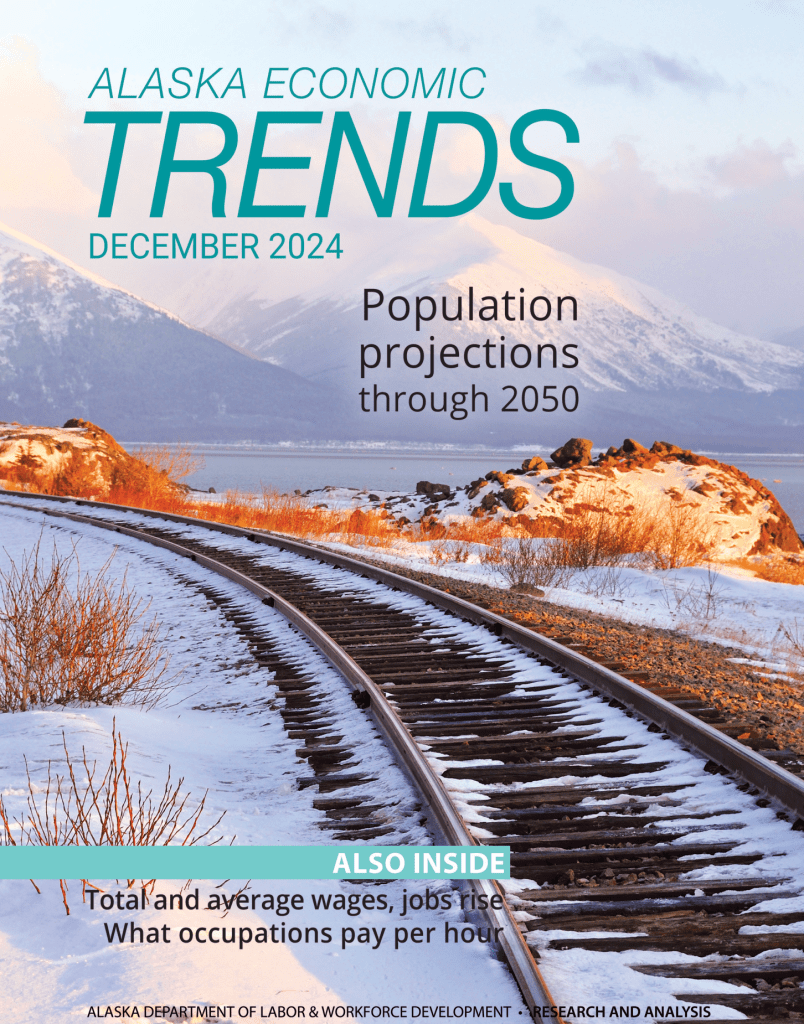
Railroad tracks at sunset along Turnagain Arm, just south of Anchorage at Mile 110.5 of the Seward Highway. Photo by Flickr user Dan Logan. Creative Commons license BY-NC 2.0.
David Howell, statewide demographer with the Alaska Dept. of Labor and Workforce Development, examines the state’s long-term population decline and the projected net migration losses from 2023 to 2050. Detailed are variables and impacts of different migration scenarios.
The December edition also features a piece on jobs, total and average wages, and the monthly Gauging the Economy report.


 UA Workforce Development News