Seattle Icebreaker Heads to Alaska for Summer

On June 7, the crew of Coast Guard cutter Healy departed its homeport at the US Coast Guard base on the downtown Seattle waterfront for a four-month deployment to the Arctic Ocean to carry out scientific research.

The Healy crew is set to conduct three missions focusing on the biology, chemistry, geology and physics of the Arctic Ocean and its ecosystems, as well as perform multi-beam sonar mapping of the Extended Continental Shelf.

For the first mission, the crew will work with 46 researchers from the National Oceanic and Atmospheric Administration and University of Alaska Anchorage to assess the biological diversity of the Chukchi Sea.

The team of scientists will use what the Coast Guard says is cutting-edge technology to identify and document the species living in the inadequately understood region.

The crew will also deploy an array of acoustic bottom moorings in support of researchers from Scripps Institute of Oceanography and the Office of Naval Research. The moorings will collect data on how climate change and decreased ice coverage is affecting the Arctic Ocean.

In the third mission, researchers from the University of New Hampshire will use multi-beam sonar mapping and bottom dredging in the Bering Sea and Arctic Ocean to further support the demarcation of the Extended Continental Shelf.

This is the 10th ECS cruise for Healy. The vessel, built in 1999, is the nation’s largest high-latitude icebreaker at 420 feet long. It has a permanent crew of 87 and is capable of other operations such as search and rescue, ship escort, environmental protection and the enforcement of laws and treaties in the polar regions.

Source: Pacific Maritime Magazine Online: Seattle Icebreaker Heads to Alaska for Summer

A Village in a Lab: UAF Works to Advance Energy Industry


The first thing you notice upon entering the 5,000-square-foot Energy Technology Facility located on the University of Alaska Fairbanks campus is the bright blue UAF-colored floor and the orderliness of everything inside. All four bays of the world-class energy lab are dedicated to the design and development of practical, cost-effective and innovative energy solutions for Alaska.

The efficiency and effectiveness of the space is a testament to the hours of hard work and years of field experience on the part of the laboratory manager, David Light, and a robust team of researchers working for the Alaska Center for Energy and Power.

Read the full article here.

Source: UAF News and Information

Wages for Anchorage/Mat-Su Area

Research and Analysis at the State of Alaska Department of Labor and Workforce Development recently published wages for the Anchorage/Mat-Su area.

The wage data are grouped into 21 occupational groupings. Click on the following group title to go to those occupations.

Source: State of Alaska Department of Labor and Workforce Development – Research and Analysis

Fishing Officials Work to Get Young People Fishing Permits

KODIAK (AP) — People in the fishing industry are looking for ways to help young fishermen join the workforce.

During the ComFish conference in Kodiak earlier this month, industry officials talked about ways to help young people overcome barriers to entry, such as permit loans, a sustainable fisheries trust and possibly community permit banks, The Kodiak Daily Mirror reported.

“Over the decades that we’ve all been here, we’ve seen and experienced a lot of changes, and it’s important to understand the trend and use our collective island experience to chart the course for our future and identify the challenges and work toward finding solutions,” said Theresa Peterson, who moderated the forum. “I think one of the greatest challenges we’re identifying is access to our fisheries for the next generation.”

University of Alaska Fairbanks professor Courtney Carothers says the age of the average permit holder has increased by 10 years since 1980 and more students aren’t fishing despite historical ties to it. Despite the decline, she said young people still know fishing has value.

“Most people that we interviewed whether they were older, younger, directly engaged in fishing or not see fisheries as integral to the health and well-being and the identity of their communities,” Carothers said. “It’s not something that people aren’t interested in figuring out how to best serve their communities.”

Alaska Sea Grant Director, Paula Cullenberg, says her organization has funded a study on ways to combat the aging fishing workforce.

“It’s not a federal fisheries management issue or a state fisheries management issue, this is an issue for our state as we look to the future of our resources and our economy,” she said.

Source: Fishing officials work to get young people fishing permits | Peninsula Clarion

Knapp Clarifies State’s Fiscal Distress Like a Superhero In a Zipper Sweater

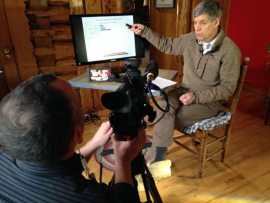
An economist in a zipper sweater doesn’t normally bring to mind a superhero, but these are not normal times.

With Alaska teetering on the brink of financial disaster like a school bus hanging off a bridge, Gunnar Knapp — director of the University of Alaska Anchorage’s Institute of Social and Economic Research — has emerged as the most trusted voice for clearly explaining the complex mess. Four months from retirement, he finds himself speaking every day, in such demand that he has never worked harder.

Click on the picture to watch the video. Read the full article here.


Source: Alaska Dispatch News