Investing in Alaska’s Workforce: Insights from the 2024 TVEP Report

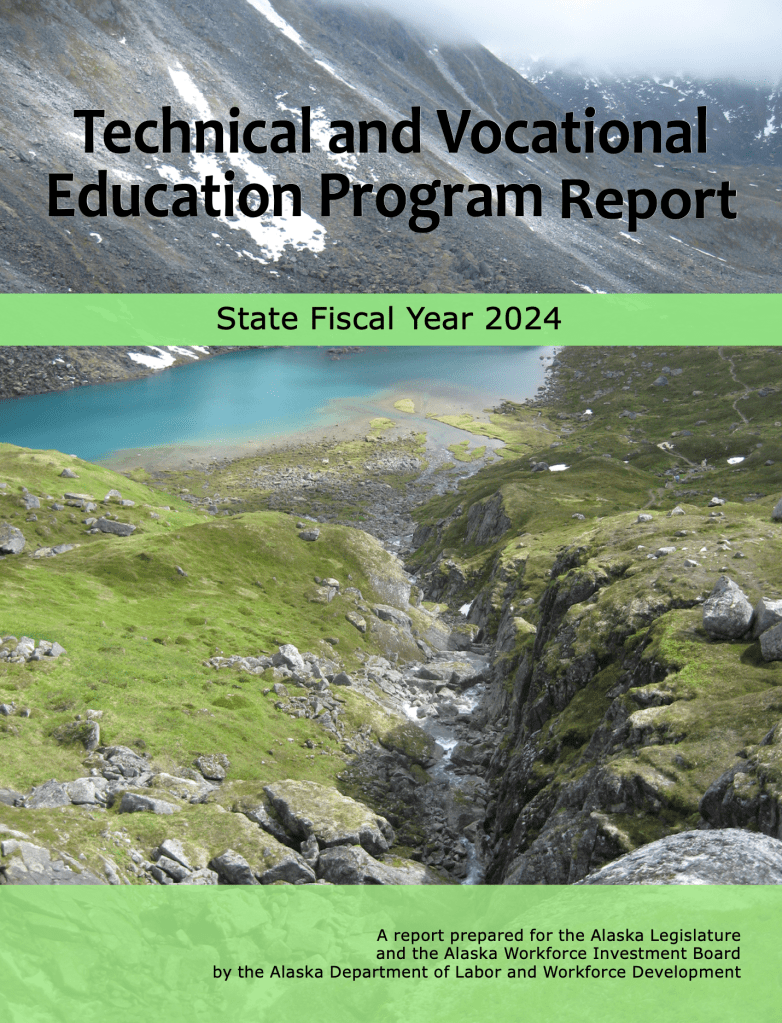
Water flows toward Lower Reed Lake, photo by Flickr user McGeez

Alaska’s economy is evolving, and so are the education and training programs designed to support it. The 2024 Technical and Vocational Education Program (TVEP) Report provides a comprehensive overview of how workforce training programs across the state are preparing Alaskans for high-demand careers.

TVEP funding plays a critical role in equipping Alaskans with the skills needed for economic resilience. This year’s report highlights the performance of training institutions while emphasizing the shifting landscape of Alaska’s workforce development — driven by regional industry needs, changing demographics, and emerging economic opportunities.

Alaska’s Workforce at a Glance

The report outlines key workforce trends across Alaska, illustrating how training efforts align with economic shifts and emerging opportunities. Some notable trends include:

Economic Diversification: Alaska is expanding beyond oil, gas, and fisheries to embrace infrastructure, tourism, and renewable energy sectors.

Vocational Training Demand: Healthcare, construction, transportation, and maritime services remain high-growth industries.

Regional Adaptations: Training programs align with regional needs, from commercial fishing in the Southwest Region to military and university-driven employment in the Interior.

Understanding these trends helps clarify why vocational training is essential for the state’s long-term prosperity. As the workforce landscape continues to evolve, training providers are stepping up to meet these changing demands.

Spotlight on the University of Alaska

The 2024 report reviews the outcomes of ten major training institutions. Among them, the University of Alaska (UA) stands out for its scale and statewide impact.

In 2024, UA received $6.26 million in TVEP funding, serving nearly 6,000 students across its campuses in Anchorage, Fairbanks, and Juneau. UA’s approach to vocational and technical education extends beyond traditional degree programs. Key highlights include:

Industry Partnerships: Collaboration with employers in oil and gas, healthcare, and engineering ensures curriculum relevance.

Expanding Online Learning: UA continues to grow its online and hybrid programs, improving access for rural students.

The Fairbanks Pipeline Training Center also received $883,000 in pass-through funding for training in construction, oil, and gas—key sectors as Alaska sees renewed pipeline infrastructure investments.

Why This Matters for Alaska

Workforce development isn’t just about filling jobs—it’s about sustaining Alaska’s economy. TVEP funding ensures industries have skilled labor while providing Alaskans with stable, well-paying careers.

The University of Alaska’s leadership in vocational training plays a crucial role in retaining talent and preparing the state’s workforce for the future. As Alaska navigates challenges like declining high school graduation rates and population outmigration, the 2024 TVEP Report makes one thing clear: investment in vocational training is investment in Alaska’s future.

By aligning training programs with industry needs and expanding access to education, Alaska is building a stronger, more resilient workforce ready to meet the challenges ahead.

CLICK HERE to read the full report.

Source: Alaska Department of Labor and Workforce Development, Research and Analysis
Parents of High-Schoolers

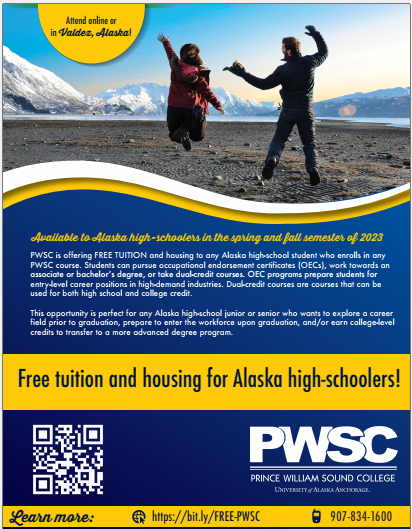
Prince William Sound College (PWSC) is offering free tuition and housing to any Alaska high-school student who enrolls in any PWSC course. Students can pursue occupational endorsement certificates (OECs), work towards an associate or bachelor’s degree, or take dual-credit courses.

Source: Prince William Sound College

Tuition-free girls’ science, art expeditions seeking applicants

Inspiring Girls* Expeditions is inviting applications for their summer 2023 tuition-free, backcountry science and art education programs.

The expeditions are open to 16- to 18-year-old high school girls. Alaskans are highly encouraged to apply, and expeditions are especially targeted towards marginalized youth who may have experienced barriers accessing science- and outdoor-focused programs. Participants are selected through a competitive application process that focuses on passion for science, art and the outdoors, rather than academic grades or past achievements. 

Applications are due Jan. 30, 2023. For more information or to learn more about the application process, please visit the program website.

Source: UAF News & Information

Alaska Fast Track students turn pandemic setbacks into career opportunities

Photo provided by UAA

“The pandemic has definitely made some permanent changes to not only our economy and the United States’ economy but the world’s economy,” said University of Alaska Anchorage Provost Denise Runge. “It’s not entirely clear what all of those changes are, but we do know that the process of education and training actually does better prepare you as an individual to be adaptable.”

And education doesn’t have to mean a college degree. For White and many other Alaskans trying to turn pandemic setbacks into silver linings, one-year career certificate programs may hold the key — and thanks to a partnership between UAA and the Municipality of Anchorage, these programs are financially within reach for more students than ever before.

On the Fast Track to better jobs

In late spring 2020, just as UAA was coming to the end of a spring semester that had been disrupted by the onset of the global pandemic, the chancellor at the time approached Runge with a challenge: She wanted Runge to co-chair a committee tasked with creating new programs to help Alaskans train for new careers — and quickly.

“She said, ‘Because of this pandemic, people are losing their jobs, they may need to train for a new career or upskill, and this is a good time to do it,’” Runge said.

Runge’s team sprang into action, working with faculty to rapidly identify programs and map out courses of study that followed two simple rules.

“No. 1, you had to be able to finish the program in a year,” said Runge, who was then serving as dean of UAA’s Community and Technical College. “No. 2, the programs had to be created out of things that we already do. That was the most important thing to me at the time as a dean, because I knew we didn’t have any extra money.”

By the time enrollment opened for the fall, UAA had created more than a dozen new Fast Track Career Certificates, all based on existing course options, designed to be completed within a year with no prerequisite work required. Students who complete Fast Track programs (in subjects as diverse as bookkeeping, phlebotomy, welding, IT help desk assistance, business and culinary arts, with more added in 2021) receive an occupational endorsement certificate, or OEC, that can give them a boost in the job market. OEC credits are also “stackable,” meaning a student who has earned an OEC can continue their education, applying the credit hours toward an associate or bachelor’s degree.

But to take advantage of the Fast Track program, students had to be able to afford it. That’s where the Municipality of Anchorage comes in.

An unusual partnership

Not long after Fast Track launched, the municipality granted UAA $3.1 million of its federal American Rescue Plan Act funds to administer scholarships to certificate-seeking students from the Anchorage area who have experienced unemployment since March 2020 or are economically disadvantaged. Eligible applicants may receive up to $9,000 for tuition, and as much as $9,000 more to cover living and other related expenses, including childcare.

Source: Alaska Fast Track students turn pandemic setbacks into career opportunities – Anchorage Daily News

Fast Track Certificates 2.0

Thanks to a $3 million American Rescue Plan Act grant, students at UAA, as well as individuals living in the Municipality of Anchorage can apply for UAA’s Fast Track program and receive funds to cover the cost of their program. (Photo by James Evans / University of Alaska Anchorage)

Last fall, UAA announced its Fast Track Certificate program. This year, the Municipality of Anchorage has collaborated with the university with a $3 million American Rescue Plan Act (ARPA) grant that broadens the scope of the Fast Track program.

The ARPA grant provides funds for 30 lower-division credit hours of a one-year occupational endorsement certificate program from UAA or qualifying program within the MOA and the associated costs up to $9,000, including living expenses, with a maximum award of $18,000 per individual.

Learn more here.

Source: Fast Track Certificates 2.0 – UAA Green and Gold